Crop guide
How to grow peppers
Growing peppers means starting transplants after frost risk has passed, matching cited spacing, and recording what happened in your bed. Cultivar and weather change the timing. There is no single trick or national planting date.
Growing guidance is general information. Timing, spacing, and care depend on cultivar, weather, soil, and local conditions. Check the sources and adjust the plan for your garden.
Steps (range, not a promise)
- 01Start seed indoors where seasons are short. Cited sheets list 6–8 weeks before outdoor set.
- 02Set transplants out after last frost at your site. Soil should be thoroughly warmed.
- 03Space plants using a cited source — sources differ by geography.
- 04Log the bed so next season is not a guess.
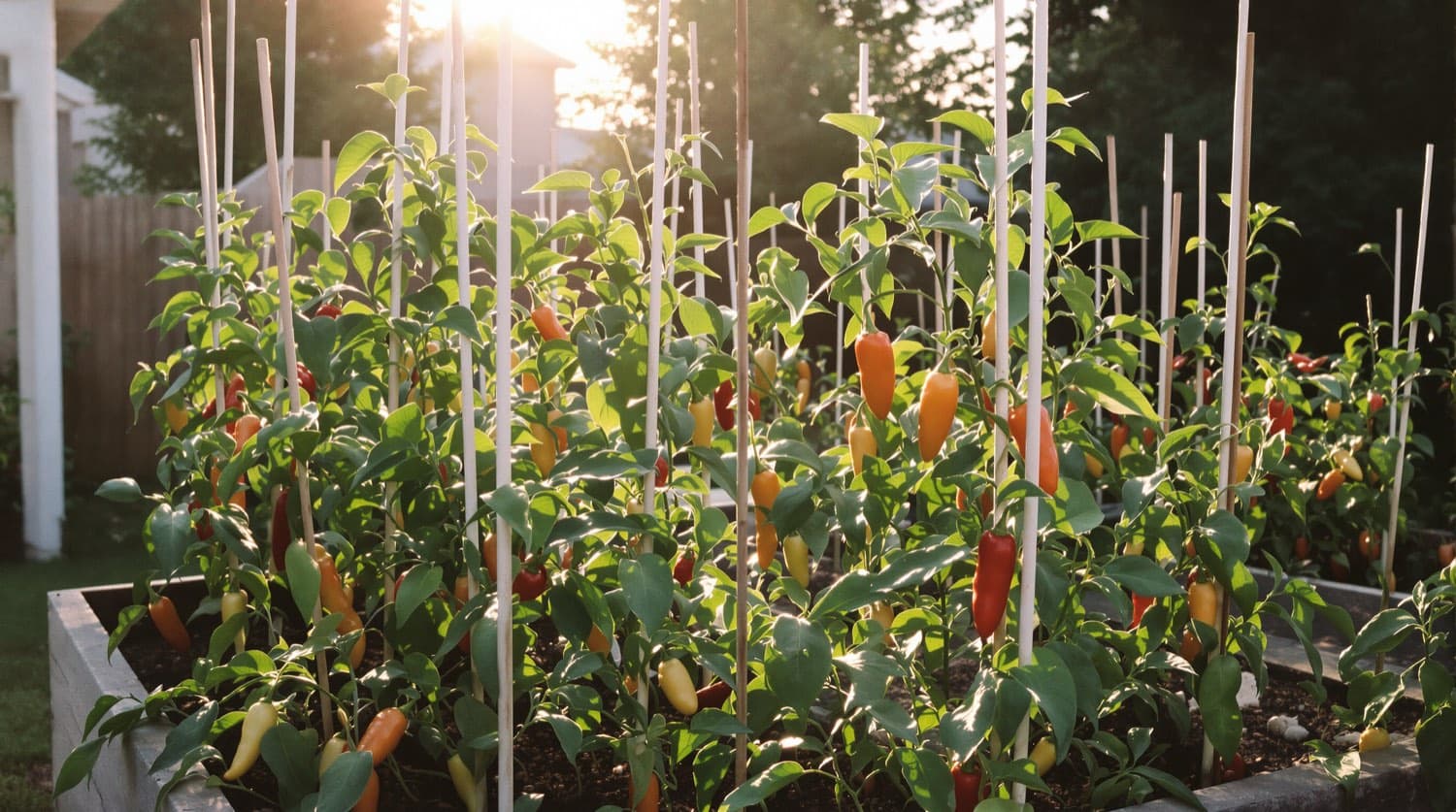
Peppers in a home garden bed.
The season, on your ground
Save this bed — freeWhen to plantCareWhen to harvestLeaves curlingLeaves turning yellowPestsGarden pests
Bell and jalapeño class notes are on the Clemson types card below. Bell fruit-set temperature is on when to plant peppers. Bell green harvest and jalapeño black-green harvest are on when to harvest peppers.
What the sources say — at a glance
One source per card. Facts are not averaged.
Clemson HGIC 1316 (South Carolina)
Set out 6- to 8-week transplants after soil has thoroughly warmed and after last frost; space 12 inches in-row, rows 3 feet (pimento differs).
Details and limits (6)
Timing
They describe setting out 6- to 8-week-old transplants after the soil has thoroughly warmed, and not planting until after the last chance of frost; start seed indoors six to eight weeks prior. Timing on their sheet — not a national plant date.
Spacing
Peppers should be spaced 12 inches apart in the row; rows 3 feet apart. Spacing on their sheet — not a BioArva average. (They list a different in-row spacing for pimento.)
Temperature
Peppers are warm-season plants; their sheet lists 70 to 85°F during the day and 60 to 70°F during the night. Temperature range on their sheet — not a BioArva climate zone.
Types
They classify peppers by hot or mild flavor. Mild peppers on their sheet include bell, banana, pimento, and sweet cherry; hot peppers include jalapeño, habanero, cayenne, large cherry, and tabasco. Classification on their sheet — not a BioArva ranking and not a Scoville score.
Mulch
They describe mulching as a way to retain consistent soil moisture and conserve water. Cultural note on their sheet — not a BioArva mulch program.
Limit
South Carolina HGIC 1316 only. Spacing is not averaged with Iowa State, UMN, or Maryland.
Iowa State Extension (Iowa)
Start seed indoors 6–8 weeks before outdoor set; transplant after frost (central Iowa: mid-May). Space 18 inches in-row, rows 24–30 inches.
Details and limits (7)
Timing
Seeds may be started indoors 6–8 weeks before the intended outdoor planting date; transplant after the danger of frost is past. In central Iowa they suggest mid-May. Geographic timing — not a national date.
Spacing
Pepper plants are commonly spaced 18 inches apart within rows; rows 24–30 inches apart. Spacing on their sheet — not a BioArva average.
Temperature
Their sheet lists daytime temperatures of 70–85°F in the context of plant growth. Temperature note on their sheet — not a yield promise.
Sun
Their sheet lists growing peppers in full sun. Light note on their sheet — not a ranking of sites.
Water
Pepper plants prefer an inch of water per week throughout the growing season; during dry periods, thoroughly water plants once a week. Water note on their sheet — not a BioArva irrigation schedule.
Mulch
Mulch is listed on their sheet. Cultural note on their sheet — not a BioArva mulch program.
Limit
Iowa pepper sheet only. Mid-May is central Iowa, not a national date.
UMN Extension (Minnesota)
Start seed indoors about eight weeks before planting out; transplant after nighttime lows are above 50°F. Space 18 inches, rows 30–36 inches.
Details and limits (7)
Timing
Start pepper from seeds indoors about eight weeks before planting outside. Timing on their sheet — not a national plant date.
Timing
Transplant outdoors after nighttime low temperatures are above 50°F. Timing on their sheet — not a national plant date.
Spacing
Space pepper plants 18 inches apart, in rows 30 to 36 inches apart. Spacing on their sheet — not a BioArva average.
Rotation
Choose a location where you have not grown tomatoes, potatoes, peppers, eggplants and tomatillos for the past three or four years. Rotation note on their sheet — not a BioArva calendar.
Seedling
Pepper plants may start to flower while still indoors; they describe pinching off clusters of flower buds until just before setting plants out. Seedling-handling note on their sheet — not a yield promise.
Transplant
When transplanting seedlings in peat pots, do not expose the top edge of the peat pot above the soil surface. Placement note on their sheet — not a BioArva pot SKU.
Limit
Minnesota sheet only. Spacing is not averaged with Clemson, Iowa State, or Maryland.
Maryland Extension (Maryland)
Set transplants after soil has thoroughly warmed; start seed 8–10 weeks before frost-free date (some types 12). Spacing 12–24 by 30–36 inches.
Details and limits (7)
Timing
Set out transplants after the soil has thoroughly warmed in the spring; start seed indoors 8 to 10 weeks before the average frost-free date (some types and cultivars require 12 weeks). Timing on their sheet — not a national plant date.
Timing
Their planting guidance says setting transplants before soil temperature reaches 65°F can leave plants stalled. Source-specific timing note—not a national plant date or diagnosis.
Hardiness
Frost will injure top growth; they describe peppers as a very tender warm-season plant grown as an annual in Maryland. Hardiness on their sheet — not a freeze-proof claim.
Spacing
Spacing 12–24 inches in-row by 30–36 inches between rows; they also list double, staggered rows in 2-foot-wide beds. Spacing on their sheet — not a BioArva average.
Container
Plant peppers in well-drained soil or containers (5-gallon minimum). Container note on their sheet — not a ranking of pots vs ground and not a BioArva pot SKU.
Sun
Full sun requires direct light at least 6 hours per day; their sheet also lists 8–10 hours per day. Light note on their sheet — not a ranking of sites.
Limit
Maryland pepper sheet only. Timing and spacing are not averaged with other states.
Utah State Extension (Utah)
Transplant when soils are 60°F or after frost danger. Allow 8–10 weeks for transplants with 6–9 mature leaves.
Details and limits (5)
Timing
Peppers should be transplanted when soils are 60°F or after all frost danger has passed. Timing on their sheet — not a national plant date.
Timing
Seed can be planted in the garden 2 weeks before the last frost. Timing on their sheet — not a national plant date.
Timing
Allow 8–10 weeks to grow transplants; transplants should have 6–9 mature leaves and a well-developed root system before planting. Timing/stage on their sheet — not a national plant date.
Spacing
Plant 4–6 pepper seeds ½ inch deep and 18 inches apart in the row; after the seedlings have two leaves, thin to a single plant. Spacing on their sheet — not a BioArva average.
Limit
Utah sheet only. Direct-seed timing is not a national rule.
Make it yours
Save the bed in the Field Book so next season is not a guess.
Sources differ
Can peppers grow in containers?
Maryland Extension lists well-drained soil or containers (5-gallon minimum). Container note on their sheet — not a ranking of pots vs ground and not a BioArva pot SKU.
What to record in the Field Book
Save the bed with the crop and the date. You may add a photo and notes. Compare entries you have recorded with each other — not with a diagnosis from this page. If you want an identification, bring the record to local Extension.
Verified suppliers only
No supplier on this page
When a partner is listed, it will be outbound and disclosed. Nothing to buy here. Fertilizer, soils, and pesticides stay off this slot.
How we know — methodology. Ranges and assertions are cited per source, not blended.