
Crop guide · Care
Tomato plant care
In-season tomato care is water, support, airflow, and watching fruit set — not a spray calendar. Keep soil moisture as even as you can, stake or cage while plants are small, and log pruning as a cultural choice. This page does not prescribe products.
Growing guidance is general information. Timing, spacing, and care depend on cultivar, weather, soil, and local conditions. Check the sources and adjust the plan for your garden.
- Water the root zone. Even moisture; big swings are a common setup for cracking.
- Mulch the soil, not the stem. Holds moisture; keeps soil off lower leaves.
- Support before it flops. Stake, cage, or trellis while plants are small.
- Prune as culture you log. Suckers and dense interiors are grower choices. Log what you did on the bed. This is not a disease treatment.
- Airflow. Space plants; consider removing only leaves that stay wet and touch soil.
- Watch flowers. Heat and drought stress are common when blossoms fall.
- Harvest check. Fruit that stays on too long splits in rain. Log counts.
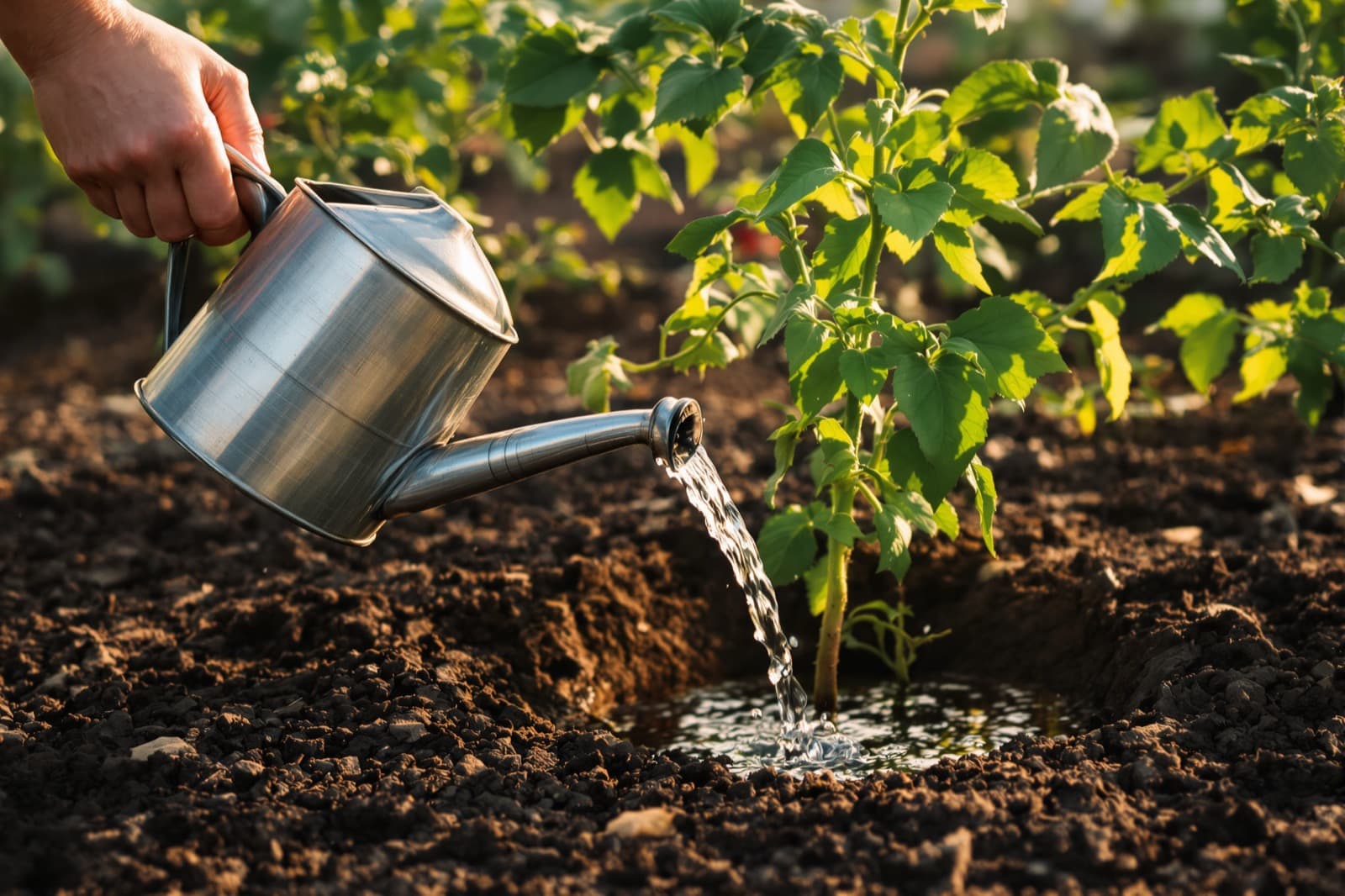
Water the soil at the base, not the leaves — even moisture beats a schedule.
Practice paths (not certification)
Conventional / IPM / organic-practice / biological-practice change which cultural habits you emphasize. None of them certifies the bed.
What the sources say — at a glance
One source per card. Facts are not averaged.
Iowa State Extension (Iowa)
Iowa State's guidance for most vegetables, including tomatoes: about 1 inch of water per week; soil type changes frequency, not that total.
Details and limits (6)
Water
About 1 inch of water per week for most vegetables including tomato.
Water
Soil type does not change the total water amount they cite, but it does change watering frequency. Frequency vs total — not a new weekly inch figure.
Water
Avoid overhead irrigation because it splashes soil. Irrigation method on their sheet — not a diagnosis.
Mulch
Mulch to conserve moisture, moderate soil temperature, and keep fruit and leaves freer of rain-spattered soil. Not a disease treatment.
Mulch
Straw listed as a mulch for tomatoes. Material example, not a product.
Limit
Iowa home-garden tomato sheet. Weekly inch figure is not averaged with Penn State or Utah.
Iowa State Extension (Iowa)
Cage-grown plants keep more foliage over the fruit; they advise against heavy shoot removal.
Details and limits (2)
Pruning
Cage-grown plants keep more foliage over the fruit; they also advise against heavy shoot removal. Cultural note on their disorders page — not a promised result and not a leaf-color diagnosis.
Limit
Iowa disorders page, a different URL from their growing sheet. Not blended with Clemson or Cornell pruning notes.
Penn State Extension (Pennsylvania)
1–1.5 inches per week; finger-check at 2 inches; 2–3 inches straw or bark. Penn State's sheet: high nitrogen, lush foliage and delayed flowering.
Details and limits (6)
Water
1–1.5 inches per week.
Water
Check with a finger; if dry at 2 inches, water the soil not the leaves; they prefer morning so leaves dry. Check language, not a daily slogan.
Mulch
Mulch plants with 2–3 inches of seed-free straw or bark chips.
Pruning
Staked plants are pruned as they grow; they describe removing suckers just above the first set of leaves. Method on their sheet — not a required cut list and not a promised result.
Nitrogen
Lush foliage and delayed flowering when nitrogen is high. Pattern on their sheet — not a feed, product, or soil-test prescription.
Limit
Pennsylvania sheet only. Weekly water is not averaged with Iowa State or Utah.
Utah State Extension (Utah, arid)
On this arid-region sheet: 1–2 inches per week, deep and infrequent; no organic mulch until soil is warmer than 75°F.
Details and limits (4)
Water
1–2 inches per week, deep and infrequent.
Mulch
Do not apply organic mulches until soils are warmer than 75°F. Geographic; not a national mulch date.
Mulch
If using plastic mulch, the stem should not touch the plastic. Geographic method note, not a national mulch rule.
Limit
Utah arid-garden sheet. Not a national watering or mulch calendar.
Maryland Extension (Maryland)
Keep the root zone moist by watering deeply and regularly during dry periods.
Details and limits (2)
Water
Keep the root zone moist by watering deeply and regularly during dry periods. Check language, not a daily slogan.
Limit
Maryland home-garden tomato page. Not a weekly inch figure.
Cornell (New York)
Prune to one or two stems by snapping suckers at 2 to 4 inches; mulch after the soil has warmed.
Details and limits (3)
Pruning
Prune to one or two stems by snapping suckers when they are 2 to 4 inches long. Logged culture, not a cure.
Mulch
Mulch after the soil has warmed, to maintain moisture.
Limit
New York guide only. Pruning is not blended with Clemson or Penn State.
Clemson HGIC 1323 (South Carolina)
Prune to one or two main stems; in wire cages, once is usually enough.
Details and limits (2)
Pruning
Prune to one or two main stems; in wire cages they say once is usually enough. Optional culture, not a disease treatment.
Limit
South Carolina sheet only.
UNH Extension (New Hampshire)
Install stakes or cages at planting; container plants need closer watering because they have no deep soil reservoir.
Details and limits (3)
Support
Install stakes or cages at planting rather than after roots are established.
Container
Container plants have no deep soil reservoir, so watering needs closer attention. Not a ranking of ground vs pot, and not a fertilizer recipe.
Limit
New Hampshire sheet only.
UGA C1089 (Georgia)
Mulch around the base of the plant for insulation and moisture.
Details and limits (2)
Mulch
Mulch around the base of the plant; they list insulation and moisture. Not a disease treatment.
Limit
Georgia publication only.
Make it yours
Save the bed in the Field Book so next season is not a guess.
Sources differ
This page does not prescribe fertilizer, baking soda, or a homemade mix. Cited source rates live on best fertilizer for tomatoes.
Which parts of a tomato plant should I remove?
There is no required cut list. Growers often consider lower leaves that stay wet on the soil, and suckers if they want a narrower plant. Log what you removed. This is not a disease treatment.
What are the signs of overwatering a tomato plant?
Check for persistently wet soil, yellowing lower leaves, and soft growth. Those signs overlap with other stresses. Consider easing irrigation and monitor new growth; contact local Extension if the plant collapses.
Should you cut back tomato plants, and how late is that choice?
Cutting back is optional culture, not a cure. Consider airflow and your season length. How late is too late depends on your frost date — plants will not reset a short season. What happens if you cut the top off is a logged choice, not a promised second crop. Monitor; do not buy a product here.
What to record in the Field Book
Save the bed with the crop and the date. You may add a photo and notes. Compare entries you have recorded with each other — not with a diagnosis from this page. If you want an identification, bring the record to local Extension.
Verified suppliers only
No supplier on this page
When a partner is listed, it will be outbound and disclosed. Nothing to buy here. Fertilizer, soils, and pesticides stay off this slot.
How we know — methodology. Ranges and assertions are cited per source, not blended.