Tomato · Fertility notes
Best fertilizer for tomatoes
There is no single best fertilizer for tomatoes. Cited university sheets start with a soil test, then list rates and timing that apply to that geography. This page does not prescribe a product, blend a BioArva NPK, or rank brands. Use a lab report, local Extension guidance, and applicable labels before changing a fertility program.
Fertilizer notes on this page are source-specific ranges, not a BioArva prescription. Use a lab report, local Extension guidance, and applicable labels before changing a fertility program.
This Field Book does not recommend homemade remedies or Epsom-salt programs; use a lab report, local Extension guidance, and applicable labels before changing a fertility program.
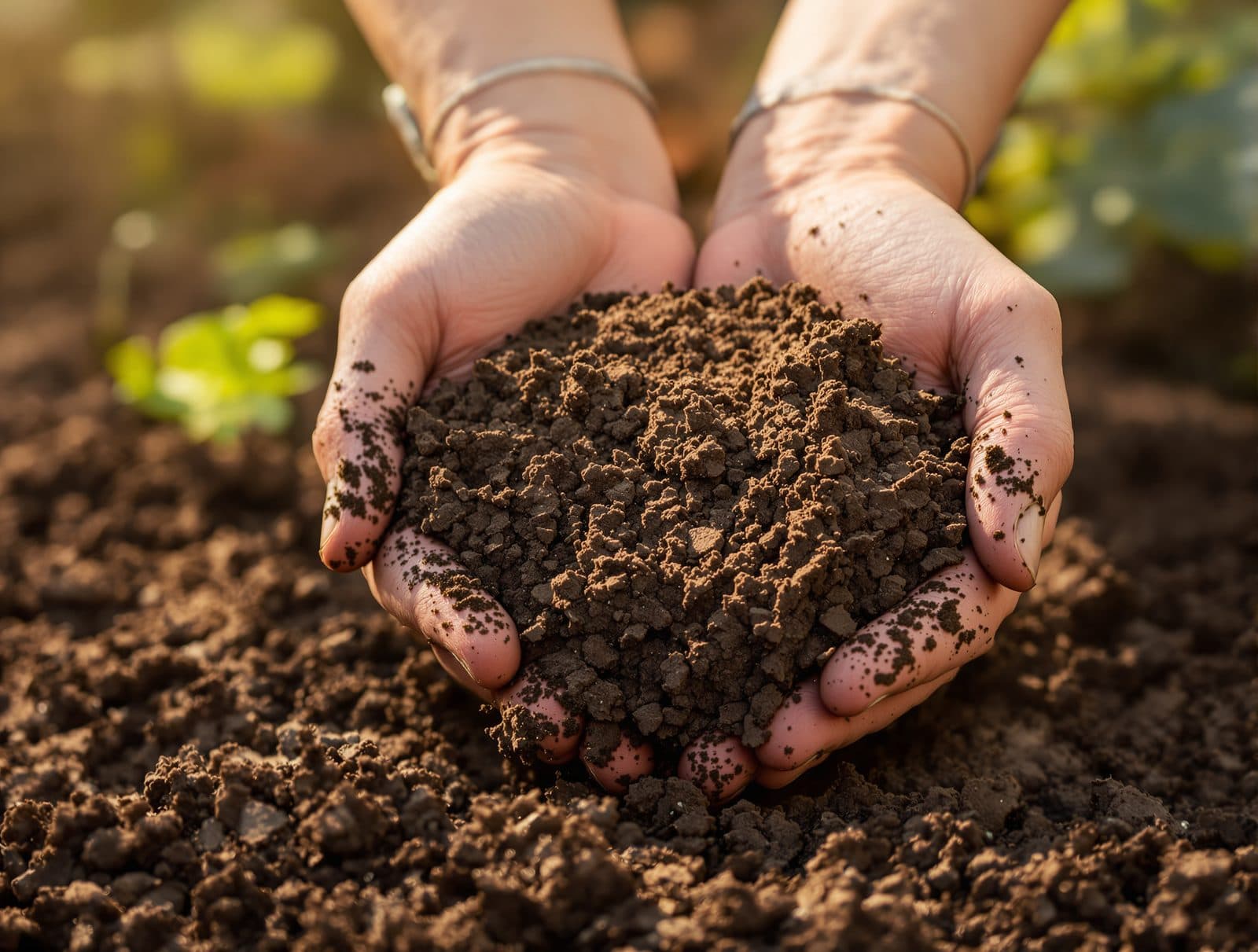
A soil sample ready for a lab report.
What the sources say — at a glance
One source per card. Facts are not averaged.
Clemson HGIC 1323 (South Carolina)
A soil test is the method they name for fertilization needs. Lime and pre-plant fertilizer per that report. Side-dress calcium nitrate on their sheet three to four weeks after planting.
Details and limits (6)
Lab
A soil test is the method they name for determining fertilization needs of the crop. Lab-first note — not a BioArva prescription and not a kit sale.
Pre-plant
Apply lime and pre-plant fertilizer according to soil-test recommendations; broadcast evenly and incorporate to around 6 inches. Process on their sheet — not a BioArva rate.
Side-dress
They describe side-dressing 1 pound of calcium nitrate — analysis they name as 15.5-0-0 — per 100 square feet (30 feet of row) three to four weeks after planting. Source rate/timing only — not a BioArva prescription.
Side-dress
On sandier soil, they say this side-dress may need to be split into two applications three to four weeks apart. Condition on their sheet — not a BioArva schedule.
Placement
Their sheet lists side-dressing fertilizer 4 to 6 inches away from the plants. Placement note only — not a BioArva prescription.
Limit
South Carolina sheet. Named analyses are theirs — not a BioArva product or ranking.
Utah State Extension (Utah)
Determine fertilizer needs with a soil test, then follow that report. Compost cap: no more than 1 inch of well-composted organic matter per 100 square feet.
Details and limits (4)
Lab
Before planting, determine fertilizer needs with a soil test and then follow the recommendations given with the test report. Local-report note — not a BioArva rate and not an amendment list.
Compost
If you fertilize with compost, they describe no more than 1 inch of well-composted organic matter per 100 square feet. Source cap — not a BioArva compost program.
Side-dress
Their sheet lists side-dressing each plant with 1/2 tablespoon of a fertilizer whose analysis they name as 21-0-0, sprinkled around the plants at 4 and 8 weeks after transplanting, then watering it in. Source rate/timing — not a BioArva prescription.
Limit
Utah garden tomato page. Named analysis is theirs — not a BioArva product.
Penn State Extension (Pennsylvania)
Absent a soil test, they describe 2–3 pounds per 100 square feet of a complete fertilizer they name as 10-10-10. High nitrogen: luxuriant foliage with delayed flowering.
Details and limits (3)
Fallback
Absent soil-test recommendations, they describe working in 2–3 pounds per 100 square feet of a complete fertilizer they name as 10-10-10. Source fallback — not a BioArva prescription, not a product, and not a substitute for a lab report.
Pattern
Their sheet describes luxuriant foliage with delayed flowering and fruiting in the context of more fertilizer or a high-nitrogen fertilizer. Source-observed pattern only — not a diagnosis, not feed advice, and not a BioArva prescription.
Limit
Pennsylvania tomato sheet. 10-10-10 is their named analysis, not a BioArva SKU.
UNH Extension (New Hampshire)
Better to use a soil test; lacking data they describe 2½ pounds of 10-10-10 (or equivalent) per 100 square feet about 2 weeks before planting.
Details and limits (3)
Fallback
They say it is better to use a soil test; lacking test data they describe 2½ pounds of a complete fertilizer they name as 10-10-10 (or the equivalent) per 100 square feet, worked in about 2 weeks before planting. Source fallback — not a BioArva prescription.
Pattern
Their sheet describes lush, vigorous foliage with little fruit production in the context of excess nitrogen. Source-observed pattern only — not a diagnosis, not feed advice, and not a BioArva prescription.
Limit
New Hampshire tomato sheet only.
Iowa State Extension (Iowa)
If no soil test, 1–2 pounds of 10-10-10 per 100 square feet before planting. Three to four weeks after transplanting, a dilute solution on their sheet.
Details and limits (4)
Fallback
If a soil test has not been conducted, they describe incorporating 1–2 pounds of all-purpose garden fertilizer they name as 10-10-10 per 100 square feet before planting. Source fallback — not a BioArva prescription.
Side-dress
Their sheet lists, three to four weeks after transplanting, a dilute fertilizer solution: 1–2 tablespoons of a fertilizer whose analysis they name as 10-10-10 (or a similar analysis) dissolved in a gallon of water, or a water-soluble fertilizer. Source method — not a BioArva prescription.
Pattern
Their sheet describes excessive vegetative (leafy) growth and possible inhibited fruit development in the context of over-fertilization. Source-observed pattern only — not a diagnosis, not feed advice, and not a BioArva prescription.
Limit
Iowa tomato sheet only.
Cornell (New York)
Sidedress about 1/2 cup of 5-10-5 per plant when fruits are about 1 inch, and again when harvest begins. High-nitrogen: three or more times N than P or K.
Details and limits (3)
Side-dress
Their sheet lists sidedressing about 1/2 cup of a fertilizer whose analysis they name as 5-10-5 per plant, worked shallowly into the top inch, when fruits are about 1 inch in diameter and again when harvest begins. Source rate/timing — not a BioArva prescription.
Pattern
Their sheet lists high-nitrogen fertilizers as those with three or more times nitrogen than phosphorus or potassium. Ratio context only — not a BioArva prescription and not a product choice.
Limit
New York tomato guide. Named analysis is theirs — not a BioArva product.
UGA C1089 (Georgia)
First fertilization at planting; not again until pollination has taken place and dime-sized fruit has appeared.
Details and limits (2)
Timing
They describe a first fertilization at planting time, and not again until pollination has taken place and dime-sized fruit has appeared. Timing on their sheet — not a BioArva calendar and not an outcome promise.
Limit
Georgia C1089 only.
Arizona Extension (Arizona)
Generally, a plant fertilized early in its life is described as not fertilized after the first fruit is set. Conditional source timing — not a BioArva stop rule.
Details and limits (2)
Timing
Their sheet lists a conditional timing note: generally, a plant fertilized early in its life is described as not fertilized after the first fruit is set. Conditional source timing note — not a BioArva stop rule and not a BioArva prescription.
Limit
Arizona sheet only.
Make it yours
Save the bed in the Field Book so next season is not a guess.
Verified suppliers only
No supplier on this page
When a partner is listed, it will be outbound and disclosed. Nothing to buy here. Fertilizer, soils, and pesticides stay off this slot.
Sampling notes live on garden soil test. In-season water and support stay on tomato plant care.
How we know — methodology. Ranges and assertions are cited per source, not blended.