Tomato · Symptom guide
Tomato hornworm
Tomato hornworm in a garden bed is a look-and-compare job. This is a species page for the caterpillar and moth named on the cited sheets — not a crop-pest list and not a spray. Cited notes are observations, not a ranked or confirmed cause. This page does not diagnose, name a product, or sell a treatment.
Cited observations are comparisons—not a confirmed diagnosis. Check the cited sources and local requirements before taking action.
Save this bed. See it coming next year.
Your checks stay in the Field Book so next season is not a guess.
Illustrative photograph — not identification proof.
Look
Compare the caterpillar, moth, egg, pupa, dropping, or cocoon in front of you with the cited notes after Other causes. Holes, missing leaves, or a green worm alone do not name a hornworm on this page.
Other causes
Crop-wide insect looks live on bugs on tomato plants. Growing notes live on how to grow tomatoes. Garden-wide looks live on garden pests. Tobacco hornworm is a comparison on cited sheets — not a ranking and not a second species page.
What the sources say — at a glance
One source per card. Facts are not averaged.
UMN Extension (Minnesota)
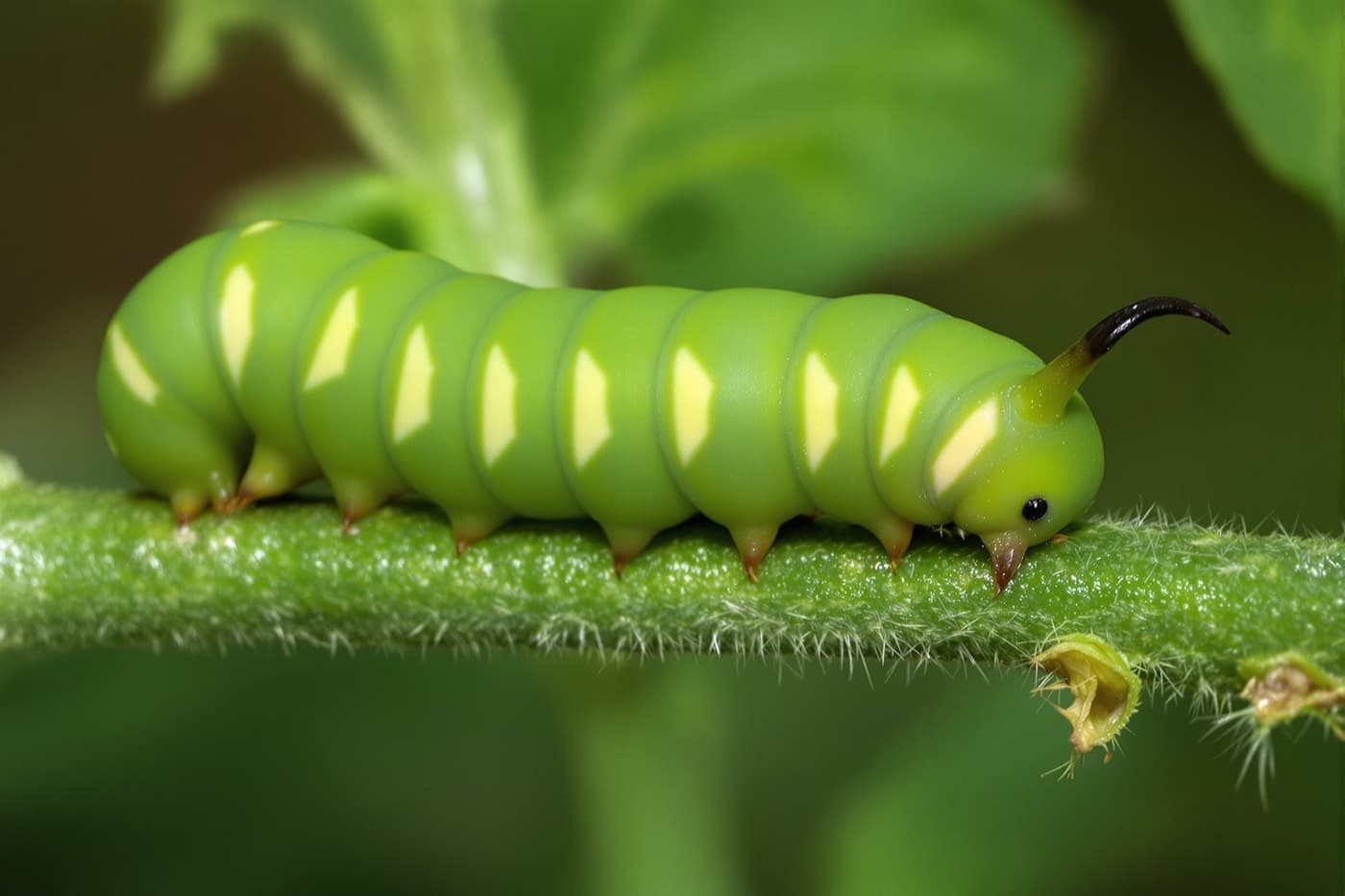
Caterpillar to four inches, eight white V-marks, black horn. Oval light-green eggs. Two generations. Moth mottled gray-brown, four-to-five-inch wingspread. Dark green or black droppings.
Details and limits (9)
Look
UMN Extension (Minnesota): caterpillars among the largest in Minnesota, up to four inches. Small tomato hornworms are yellow to white with no markings. Large caterpillars develop eight white V-shaped marks on each side. Tomato hornworms have a black projection or horn on the last abdominal segment. Favorite plant is tomato. They chew leaves and can chew holes in fruit. Identification, host, and damage as observation. Not a kill or spare instruction. Bare hornworm and feeder-moth strings are not targeted on this page.
Moth
UMN Extension (Minnesota): adult moths are large, heavy-bodied insects with narrow front wings. Mottled gray-brown with yellow spots on the sides of the abdomen. Wingspread four to five inches. Hindwings have alternating light and dark bands. Minnesota moth ID. Not “five pairs.” Not a feeder-moth page.
Eggs
UMN Extension (Minnesota): females deposit oval, smooth, light green eggs on lower and upper leaf surfaces. Caterpillars hatch, begin to feed, and are full-grown in three to four weeks. Minnesota egg look and sit. Not a national calendar.
Life cycle
UMN Extension (Minnesota): tomato hornworms survive winters as pupae and emerge as adult moths in spring. Mature caterpillars drop off plants and burrow into the soil to transform into pupae. Moths emerge in two weeks to begin a second generation, during mid-summer. Second-generation moths deposit eggs on host plants such as tomato. Caterpillars feed until late summer or early fall and then pupate. Pupae remain in the soil through winter. Minnesota generations (two). Not averaged with other states. Soil depth and tongue-case are not stated on this sheet.
Hosts and damage
UMN Extension (Minnesota): tomato is the host of choice, but they have also been found on potato, eggplant and pepper. Weeds named as alternate hosts: horsenettle, jimsonweed and nightshade. Large numbers of caterpillars can occur in home gardens and can quickly defoliate plants. Feeding starts on the leaves on the upper parts of the plants. Caterpillars blend in with the leaves. Older tomato hornworms can destroy several leaves as well as the fruit. As they become larger, the amount of defoliation increases. The last caterpillar stage consumes nearly as much as all the younger stages combined. Hosts and defoliation as observation. Not a ranking. Pepper is not claimed as a keyword on this page.
Droppings
UMN Extension (Minnesota): as they feed, they create dark green or black droppings that are clearly visible. Frass as observation. Not fertilizer. Not a find-protocol beyond the look.
Cocoons
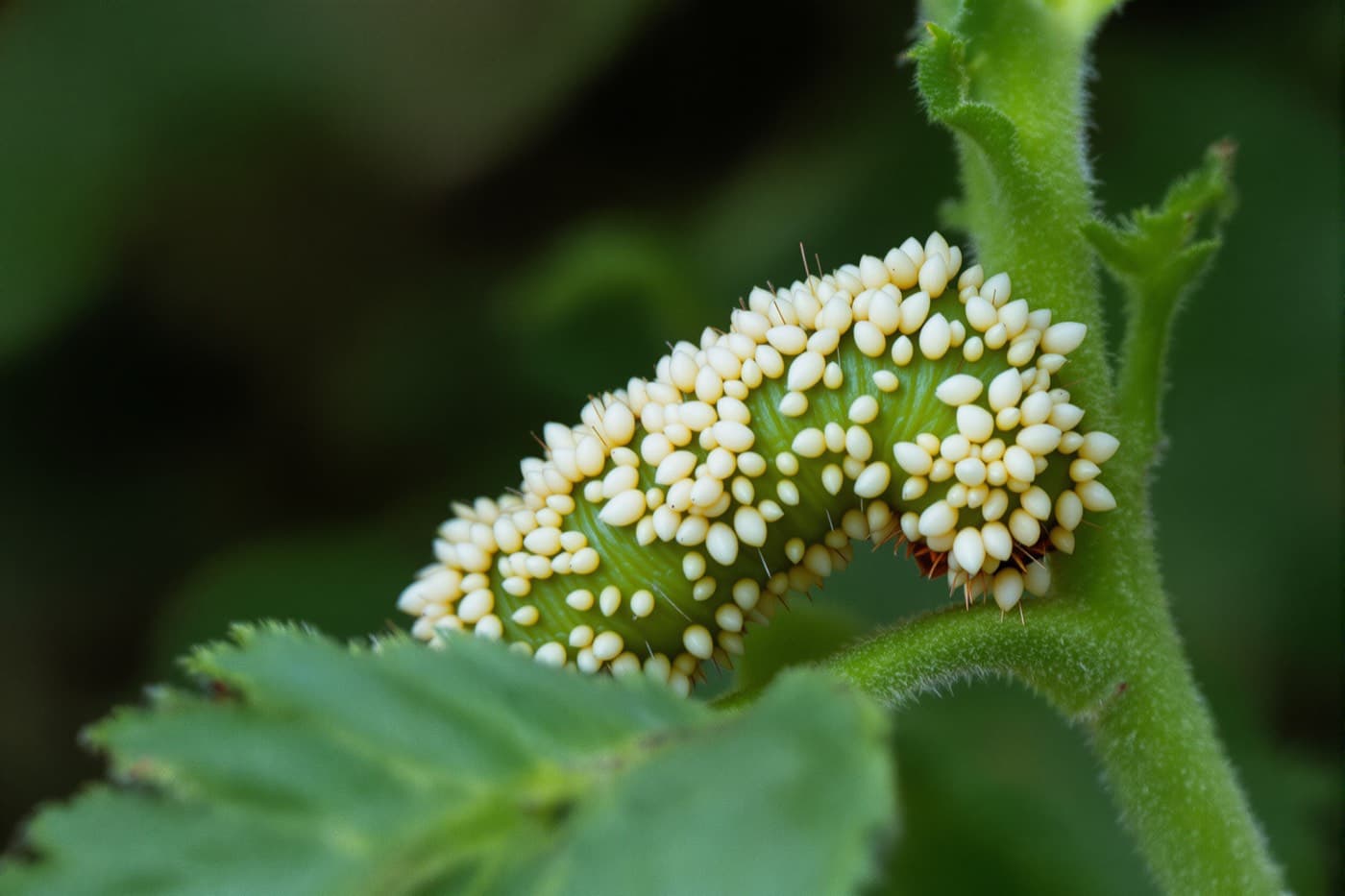
UMN Extension (Minnesota): parasitized by a small braconid wasp, Cotesia congregatus. The cocoons look like white rice protruding from the hornworm’s body. Observation. Distinct from the Missouri IPM1028 figure. “Leave them,” “kill when they emerge,” and efficacy are not collected.
Containment
UMN Extension (Minnesota): physical removal (hand-pick) is listed as a management practice on that sheet. Containment context only. Not “kill.” Soap and “most effective” language on that sheet are not collected. Hand-pick is named as a listed practice, not a program and not an outcome.
Limit
Minnesota tomato-hornworm sheet. Identification, moth, eggs, two generations, hosts, defoliation, droppings, rice-like cocoons, and hand-pick as listed practice. Not a product, rate, efficacy, or kill/spare instruction. Tillage, UV scouting, and “five pairs” of spots are not collected.
Missouri IPM (Missouri)
Tomato hornworm: V-shaped white lines, black horn. Tobacco: seven oblique white lines outlined in black, red horn. Two generations. Pupae five to six inches below soil.
Details and limits (6)
Compare
Missouri IPM (Missouri): tomato hornworm (Manduca quinquemaculata) — lateral white lines V-shaped, pointing toward the head; not outlined in black; horn tends to be black. Tobacco hornworm (Manduca sexta) — seven oblique white lines outlined in black; horn usually red. Late-instar tobacco hornworm caterpillars have seven diagonal stripes on their body and their horn is usually red. Comparison table on that sheet. Not a ranking. Marks and horn color are the collected difference — not a winner.
Hosts
Missouri IPM (Missouri): both feed primarily on tomato and tobacco; also eggplant, pepper, potato. Named-host list. Observation only. Present June–September on that sheet. Not a national calendar. Pepper, eggplant, and potato are named hosts on that sheet, not separate pest pages.
Moth and eggs
Missouri IPM (Missouri): usually two generations of hornworms produced each summer. Adult moths emerge in mid- to late spring. Both species are mottled gray-brown moths with four- to five-inch wingspans. After mating, females lay their small eggs, which often are undetected, on the upper and lower surface of tomato leaves and other host plants. Missouri moth, egg, and generation. Not blended with North Carolina counts.
Instars and pupa
Missouri IPM (Missouri): tomato hornworms undergo five larval or instar stages in three to four weeks. All five instars feed on plants. The first small instar is whitish-yellow with five pairs of prolegs used to grip onto plant stems and leaves. When fully grown, caterpillars are usually green, but dark brown types can also develop. Full-grown caterpillars of the second generation, which develop in mid- to late summer, drop off plants to pupate. Pupae overwinter about five to six inches below the soil surface. Missouri instars and soil depth. No tongue-case on this sheet. Tillage on that sheet is not collected.
Damage and droppings
Missouri IPM (Missouri): both types of hornworm caterpillars devour leaves and can completely defoliate tomato plants. Hornworms also chew holes in green tomato fruit, especially during dry weather. Feeding damage generally begins on the upper leaves of tomato plants. Dark greenish-black droppings left by caterpillars when feeding often are present on the foliage. Damage and frass as observation. Fruit-hole is not a diagnosis from holes alone.
Limit
Missouri IPM hornworm sheet. Comparison, named hosts, two generations, moth wingspan, instars, five-to-six-inch overwintering depth, defoliation, and droppings. Not a ranking, spray, or outcome. June–September is that sheet’s window, not BioArva’s. Tongue-case is not on this sheet.
Maryland Extension (Maryland)
Tobacco or tomato hornworm: large green caterpillar chewing tomato leaves.
Details and limits (2)
Look
Maryland Extension (Maryland): tobacco or tomato hornworm — a large green caterpillar chewing tomato leaves. Identification only. The crop-pest router at /crops/tomato/pests names this look without claiming the species vocabulary.
Limit
Maryland tomato-problems key. Appearance only. Not a keyword target beyond this species page. Not a spray. Mid- to late-summer timing and wasp-parasitoid notes on that key are not collected as a program.
Missouri Extension IPM1028 (Missouri)
Cocoons of a parasitic wasp on a tomato hornworm, shown as a figure on that sheet.
Details and limits (2)
Cocoons
Missouri Extension IPM1028 (Missouri): cocoons of a parasitic wasp on a tomato hornworm (figure on that sheet). Braconid-cocoon observation. Not an instruction to spare or kill. Not an efficacy claim.
Limit
Missouri IPM1028 figure context. Observation only. Kill/spare judgment, sting/touch/toxic, Bt/spray, recover, and fertilizer-from-frass stay closed.
NC State Extension (North Carolina)
Pupae dark brown with a handle-like tongue case. Tomato moth: five abdominal spots. Tobacco moth: six. Two to three generations in North Carolina.
Details and limits (6)
Pupa
NC State Extension (North Carolina): pupae of both species are dark brown and have a handle-like tongue case on the exterior. Hornworms overwinter as pupae in the soil. NC tobacco publication. Tongue-case lives here. Not “jug-handle” beyond handle-like tongue case. Not a tillage protocol.
Moth spots
NC State Extension (North Carolina): tomato hornworm moths have five spots on the abdomen; tobacco hornworm moths have six. Spot count on this sheet. Not “five pairs.” Not orange-yellow.
Generations
NC State Extension (North Carolina): two to three hornworm generations occur in North Carolina, depending upon temperature. Adults begin to emerge in early June. North Carolina geography. Generations 2–3 versus two in Minnesota and Missouri stay in Sources differ. Not averaged.
Compare
NC State Extension (North Carolina): larval tomato hornworms have eight chevrons on each side and a bluish black horn. Larval tobacco hornworms have seven diagonal stripes on each side and a red posterior horn. Comparison on that sheet. Chevron / bluish-black versus Missouri V-shaped / black stay in Sources differ. Not a ranking.
Eggs
NC State Extension (North Carolina): hornworm eggs are round, pale green, and laid on the upper surface of tobacco leaves. Tobacco-leaf placement on that sheet — not a tomato-egg placement claim. Round pale green versus Minnesota oval light green on tomato leaf surfaces stays in Sources differ.
Limit
NC State tobacco publication. Tongue-case, abdominal spot counts, NC generations, larva comparison, and tobacco-leaf eggs. Not a tobacco-pest page. Not a tomato-egg claim. Not blended with Minnesota or Missouri.
Sources differ
Make it yours
Save the bed in the Field Book so next season is not a guess.
What does a tomato hornworm turn into?
UMN Extension (Minnesota): adult moths are large, heavy-bodied insects with narrow front wings; mottled gray-brown with yellow spots on the sides of the abdomen; wingspread four to five inches; hindwings with alternating light and dark bands. Missouri IPM (Missouri): both species are mottled gray-brown moths with four- to five-inch wingspans. Adult moth as cited — not a hummingbird-moth and not a feeder-moth page.
What attracts tomato hornworms?
Missouri IPM (Missouri) names hosts: both tomato hornworm and tobacco hornworm feed primarily on tomato and tobacco; also eggplant, pepper, potato. Named-host list — observation only, not a lure or an attractant product.
Do tomato worms eat anything besides tomato plants?
Missouri IPM (Missouri): tomato and tobacco first; also eggplant, pepper, potato. UMN Extension (Minnesota): tomato is the host of choice; also found on potato, eggplant and pepper; weeds named horsenettle, jimsonweed and nightshade. Named-host lists — not a feeding trial and not a pepper-pest page.
What does hornworm poop look like?
UMN Extension (Minnesota): as they feed, they create dark green or black droppings that are clearly visible. Missouri IPM (Missouri): dark greenish-black droppings often are present on the foliage. Droppings as observation — not fertilizer and not a find-protocol beyond the look.
Illustrative photograph — not identification proof.
How we know — methodology. Ranges and assertions are cited per source, not blended.