Squash · Symptom guide
Squash vine borer
Squash vine borer in a garden bed is a look-and-compare job. This is a species page for the moth and larva named on the cited sheets — not a squash-bug page and not a spray. Cited notes are observations, not a ranked or confirmed cause. This page does not diagnose, name a product, or sell a treatment.
Cited observations are comparisons—not a confirmed diagnosis. Check the cited sources and local requirements before taking action.
Save this bed. See it coming next year.
Your checks stay in the Field Book so next season is not a guess.
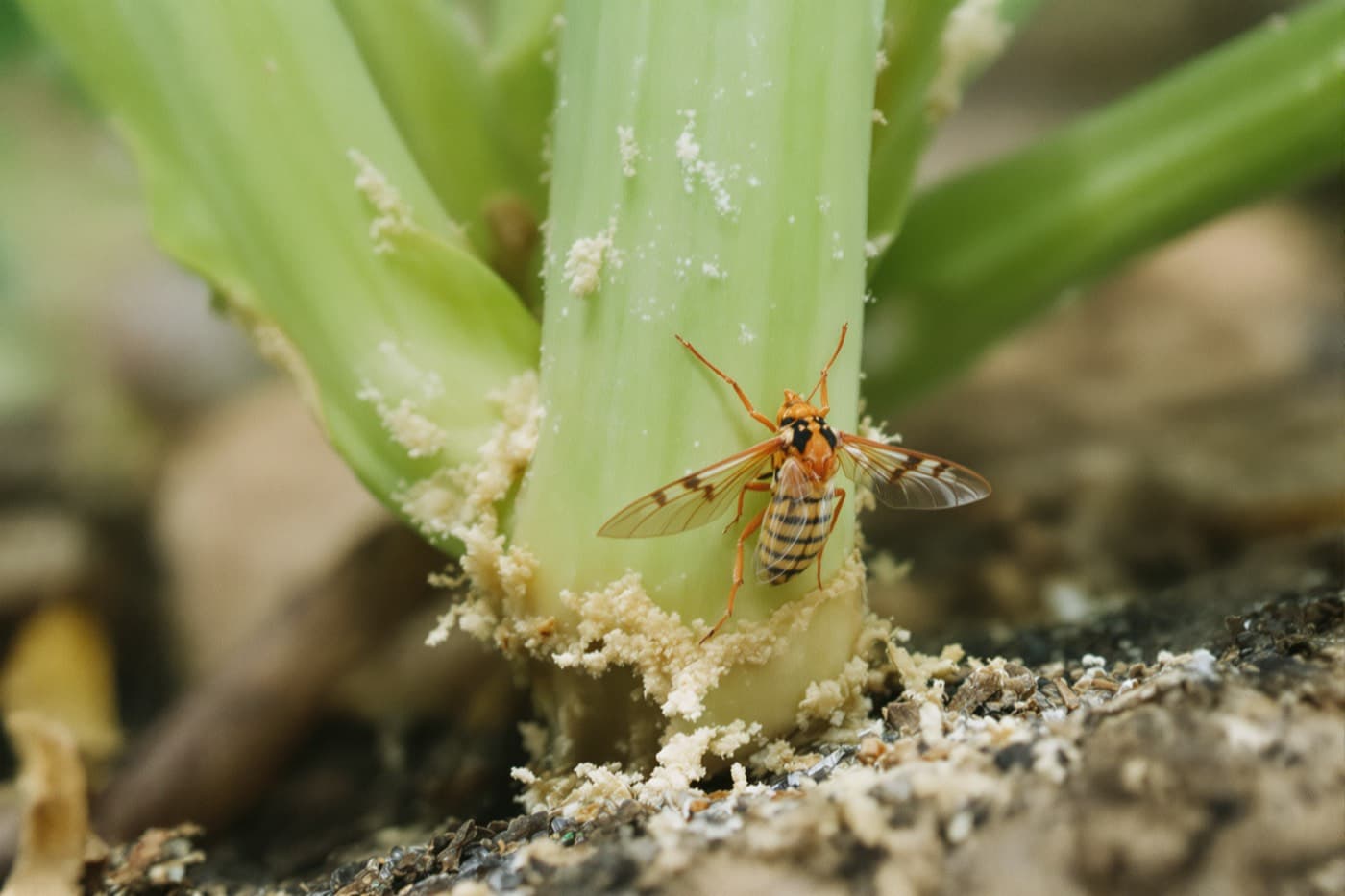
Illustrative photograph — not identification proof.
Look
Compare the moth, egg, larva, hole, or frass in front of you with the cited notes after Other causes. Wilt alone does not name a vine borer on this page.
Other causes
Crop-bug notes live on squash bugs. Growing notes live on how to grow squash. Zucchini notes live on zucchini. Garden-wide looks live on garden pests.
UMN Extension squash-bug sheet versus UMN squash-vine-borer sheet (Minnesota): squash bug (Anasa tristis) is a flattened true bug, 5/8 inch, dark gray to dark brown. Squash vine borer adult is a day-flying moth. Different insect. Comparison only; squash-bug looks stay on squash bugs.
What the sources say — at a glance
One source per card. Facts are not averaged.
UMN Extension (Minnesota)
Adult: day-flying moth that mimics wasps; about 1/2 inch; orange abdomen with black dots; first pair of wings metallic green; hind pair clear, often folded at rest.
Details and limits (4)
Adult
UMN Extension (Minnesota): adult is a day-flying moth that mimics wasps; about 1/2 inch; orange abdomen with black dots; first pair of wings metallic green; hind pair clear, often folded at rest. Identification. Not a beetle. Pumpkin is named on that sheet — not claimed as a keyword on this page.
Eggs and larvae
UMN Extension (Minnesota): eggs flat, brown, about 1/25 inch, laid singly at the base. Hatch about one week. Larvae white or cream with brown heads, to almost an inch; bore into stems. Active mid-June through July. One generation per year; larvae overwinter in the soil. Minnesota calendar. Not a national flight.
Hosts and signs
UMN Extension (Minnesota): feeding inside vines and crowns of summer squash, winter squash, and pumpkins. Yellowing of leaves and wilting. Cucumbers and melons less frequently affected. Hosts and signs as observation. Wilt alone is not a diagnosis. Cucumber and pumpkin keywords are not claimed.
Limit
Minnesota squash-vine-borer sheet. Identification, Minnesota timing, hosts, and signs. Not a prevention promise. Stem-cut, Bt, and traps not collected.
UMN Extension (Minnesota)
Row covers to exclude until plants begin to flower. Cucumbers, melons, and Cucurbita moschata squash or pumpkins listed as relatively tolerant. Summer squash is very susceptible.
Details and limits (2)
Row cover
UMN Extension (Minnesota): row covers to exclude squash vine borers until plants begin to flower. Several cucurbits listed as relatively tolerant, including cucumbers, melons, and squash or pumpkins in Cucurbita moschata. Summer squash is very susceptible. Minnesota sheet. Row-cover-until-flowering and named tolerance. Not a prevention promise. Stem-cut, Bt, and traps not collected.
Limit
UMN common-insects sheet. Row-cover-until-flowering and named tolerance only.
Wisconsin Horticulture (Wisconsin)
Day-flying clearwing; wasp-like. Forewings greenish-brown; hindwings transparent with reddish-brown fringe. Wingspan 1–1.5 inches. Body rusty orange with black bands. Larvae pale, segmented, dark head, up to 1 inch.
Details and limits (2)
Look
Wisconsin Horticulture (Wisconsin): day-flying clearwing; wasp-like. Forewings greenish-brown; hindwings transparent with reddish-brown fringe. Wingspan 1–1.5 inches. Body rusty orange with black bands. Larvae pale, segmented, dark head, up to 1 inch. Eggs small, brownish, at the base; hatch 7–10 days; feed 14–30 days. Light brown sawdust-like frass. Wilt may be confused with bacterial wilt or Fusarium — look for entrance holes near the base. Identification, signs, and differential. Not a save-the-plant protocol.
Limit
Wisconsin squash-vine-borer article. ID, signs, and wilt differential. Not a survival claim.
Wisconsin Horticulture (Wisconsin)
Moth ¾–1 inch, 1–1½ inch wingspan; metallic greenish-black forewings; clear hindwings; orange-and-black hind legs. Eggs flattened, oval, dull-red to brown, laid individually.
Details and limits (2)
Look
Wisconsin Horticulture (Wisconsin): moth ¾–1 inch, 1–1½ inch wingspan; metallic greenish-black forewings; clear hindwings; orange-and-black hind legs. Eggs flattened, oval, dull-red to brown, laid individually. Hatch 7–15 days. Larva cream, wrinkled, brown head. Rarely in cucumbers or melons. Cannot complete development except in summer squash, winter squash, or pumpkins. Separate URL from the Wisconsin squash-vine-borer article. Egg color versus UMN brown stays in Sources differ.
Limit
Wisconsin Melittia cucurbitae article — a second URL, own card. Identification and host notes. Not a cucumber-pest page.
Maryland Extension (Maryland)
Eggs: tiny brown flattened ovals, attached singly. Larvae: wrinkly, white to cream, hairless, up to 1 inch, dark head. Adult: fat, black, clear-winged moth with orange legs; wasp-like.
Details and limits (3)
Stages
Maryland Extension (Maryland): eggs tiny brown flattened ovals, attached singly. Larvae wrinkly, white to cream, hairless, up to 1 inch, dark head. Pupa dark brown, shiny, tapered; cocoon black, rough. Adult fat, black, clear-winged moth with orange legs and orange-and-black abdomen; appears similar to a wasp. Overwinters as pupa about 2 inches under soil. 1–2 generations a year. Maryland geography. Generations 1–2 versus Minnesota one stay in Sources differ.
Hosts and signs
Maryland Extension (Maryland): hosts summer and winter squash and pumpkin; very rarely cucumber, gourd, melon. Frass: greenish-white sawdust out the entrance hole; stem near hole feels mushy. Frass color versus Wisconsin light brown stays in Sources differ. Cucumber, gourd, and melon keywords are not claimed.
Limit
Maryland squash-vine-borer vegetables sheet. Stages, hosts, and signs. Not a prevention promise.
Maryland Extension (Maryland)
Wilted leaves or vines; hole at the base or lowest 8 inches; sawdust-like frass. Row cover or insect mesh when seedlings emerge; remove during bloom for pollination.
Details and limits (2)
Signs
Maryland Extension (Maryland): wilted leaves or vines; hole at the base or lowest 8 inches; sawdust-like frass. Row cover or insect mesh when seedlings emerge; remove during bloom for pollination. Bacterial wilt: leaves recover at night then wilt again — different pattern on that key. Signs plus row-cover-until-bloom. Not a prevention promise. Not a survival claim.
Limit
Maryland squash-problems key. Signs, row-cover context, and bacterial-wilt differential. Not a save-the-plant protocol.
Sources differ
Make it yours
Save the bed in the Field Book so next season is not a guess.
Do vine borers stay in the soil?
UMN Extension (Minnesota): larvae overwinter in the soil. Maryland Extension (Maryland): overwinters as pupa about 2 inches under soil. Observation on those sheets — not a tillage protocol.
Do vine borers eat cucumbers?
UMN Extension (Minnesota): cucumbers and melons less frequently affected. Wisconsin Horticulture (Wisconsin): rarely in cucumbers or melons; cannot complete development except in summer squash, winter squash, or pumpkins. Maryland Extension (Maryland): very rarely cucumber, gourd, melon. Not a cucumber-pest page.
How we know — methodology. Ranges and assertions are cited per source, not blended.