Tomato
Tomato companion plants
Tomato companion plants here are source-bound layout and named pairing contexts, not a universal chart. Extension sheets describe space, shade, and timing around tomatoes, then separately record rotation and disease-host planning. This page does not rank plants, promise pest control, yield, or flavor, or tell you what is “best.”
One source per card. Not a printable companion chart and not a spray plan. Time-separated rotation guidance is not coexistence advice.
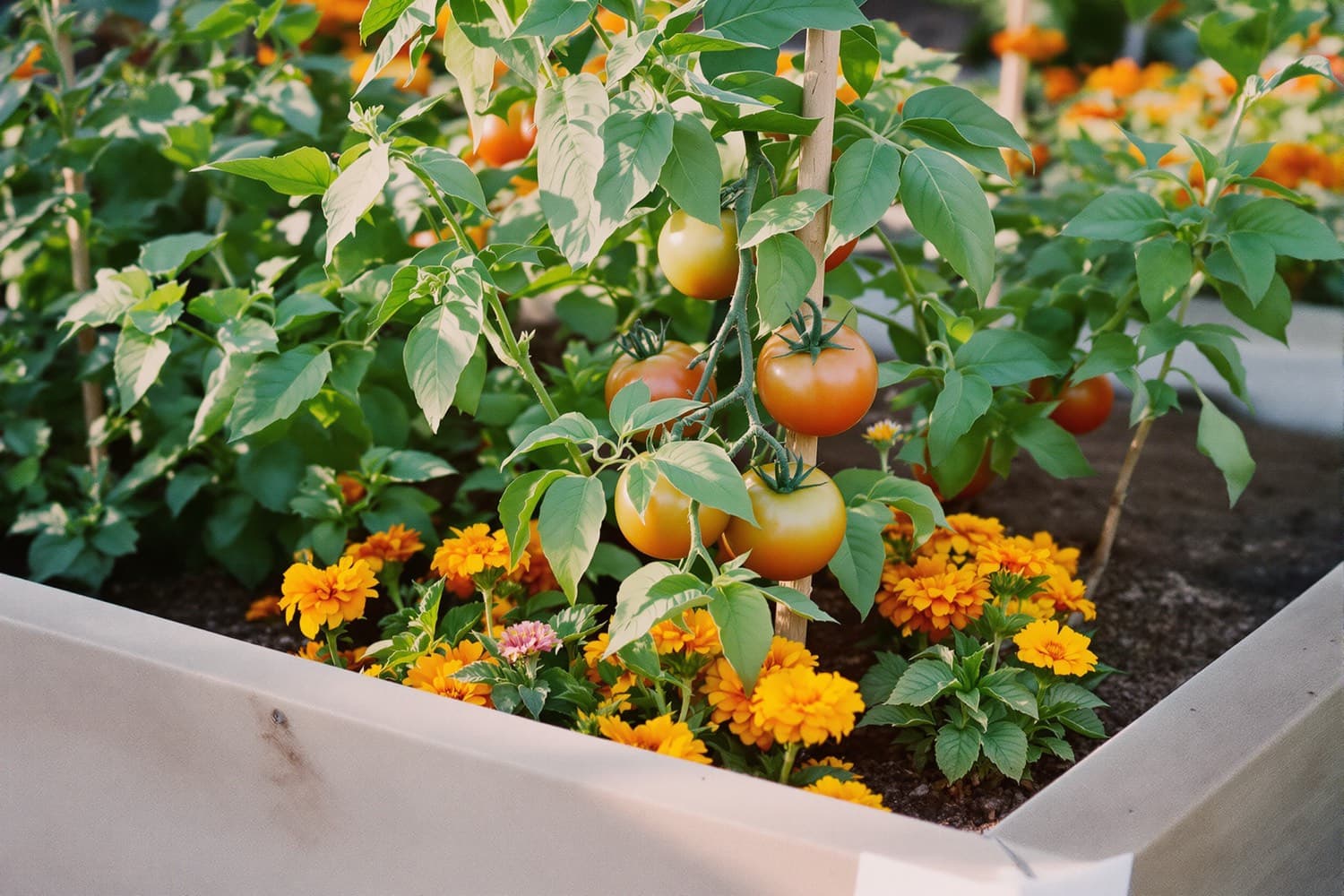
Illustrative photograph — not a cited pairing.
What the sources say — at a glance
One source per card. Facts are not averaged.
UMN Extension (Minnesota)
Plant lettuce, spinach, or basil early, then transplant tomatoes into the same bed as that crop matures. Spatial succession — not pest-control or flavor.
Details and limits (2)
Layout
This source describes planting lettuce, spinach, or basil early, then transplanting tomatoes (or peppers) into the same bed as that early crop matures. Tomato + lettuce/spinach/basil spatial succession — not a pest-control pairing, not basil-improves-flavor, and not a BioArva calendar.
Limit
Minnesota companion sheet. Not a ranking and not a spray plan.
Maryland Extension (Maryland)
Low-growing salad greens on the north side of tomatoes. Peas at cage bases as a wind shield. Basil-tomato-basil as a row arrangement example.
Details and limits (4)
Layout
This source describes planting low-growing, shade-tolerant salad greens on the north side of tomatoes (also naming corn or eggplants). Tomato + salad greens shade arrangement — not a companion ranking.
Pairing
This source describes planting peas at the base of tomato cages on the north side in early spring; when tomatoes go in later, the filled-in pea vines act as a wind shield. Tomato + pea spatial pairing — not pest-control or flavor.
Pairing
This source lists planting arrangement as alternate plants within a row, with basil-tomato-basil-tomato as the example. Tomato + basil spatial arrangement — not a flavor claim, not pest-control, and not a BioArva pairing rule.
Limit
Maryland companion sheet. Arrangement is not a pest-control pairing.
WVU Extension (West Virginia)
Interplant smaller cool-season plants such as spinach, beets, or lettuce between larger, slow-growing vegetables such as tomatoes. Shade after the small crop matures.
Details and limits (2)
Layout
This source describes interplanting smaller cool-season plants such as spinach, beets, or lettuce in between larger, slow-growing vegetables such as tomatoes. Once the smaller crops mature, the larger plants’ canopy will offer shade. Tomato + spinach/beet/lettuce spatial/shade context — not a pest-control pairing and not a yield claim.
Limit
West Virginia companion sheet. Not a yield claim.
Clemson Extension (South Carolina)
Choose a well-drained site where tomatoes, peppers, eggplant, or potatoes have not been grown for at least three years. Rotation/site context — not “never plant together.”
Details and limits (2)
Rotation
This source says to choose a well-drained site where tomatoes, peppers, eggplant, or potatoes have not been grown for at least three years. Tomato + pepper/eggplant/potato rotation/site context — source-bound planning, not “never plant together” and not a diagnosis.
Limit
South Carolina HGIC tomato sheet. Time-separated rotation is not coexistence advice.
Clemson Extension (South Carolina)
Tomatoes and related vegetables not more than once in three years on the same land. Corn listed as a rotation crop. Disease-section planning — not a pairing chart.
Details and limits (5)
Rotation
This source says tomatoes and related vegetables such as potatoes, peppers, and eggplants should not be planted on the same land more than once in three years. Tomato + potato/pepper/eggplant rotation context — source-bound planning, not “never plant together.”
Rotation
This source lists corn as a rotation crop with tomatoes. Tomato + corn rotation listing — not a beside-tomatoes pairing and not a control claim.
Rotation
In southern blight management, this source says do not plant tomatoes after beans, pepper, or eggplant. Tomato + bean/pepper/eggplant rotation context for that disease on their sheet — source-bound planning, not “never plant together,” not a diagnosis, and not a pesticide path.
Rotation
Because tomato pith necrosis affects other plants in the tomato family such as eggplants and peppers, this source says the site for the tomatoes should not be planted again with solanaceous plants for at least a year. Tomato + eggplant/pepper rotation context for that disease — not coexistence advice.
Limit
Clemson disorders URL. Disease-section rotation is not a companion verdict.
Cornell (New York)
To reduce root disease risk, don’t plant on soils that have recently grown tomatoes, potatoes, peppers or eggplant for at least two years.
Details and limits (2)
Rotation
This source says, to reduce root disease risk, don’t plant on soils that have recently grown tomatoes, potatoes, peppers or eggplant for at least two years. Tomato + potato/pepper/eggplant rotation context — source-bound planning, not coexistence advice.
Limit
New York tomato guide. Two-year gap is not Clemson’s three-year note.
Iowa State Extension (Iowa)
Nightshade family grouped for rotation: eggplant, pepper, potato, tomato, tomatillo, ground cherry, husk cherry. Same family not in the same location for 3 to 4 years.
Details and limits (2)
Rotation
This source groups eggplant, pepper, potato, tomato, tomatillo, ground cherry, and husk cherry in the nightshade family (Solanaceae) for rotation planning, and says gardeners should not plant vegetables belonging to the same plant family in the same location for 3 to 4 years (or 5+ if possible). Family-rotation planning — not a companion chart.
Limit
Iowa rotation sheet. Interval is not averaged with other sources.
Penn State Extension (Pennsylvania)
Vegetables in the solanaceous group, including tomatoes, peppers, and potatoes, are some of the least tolerant of juglone. Siting context — not a companion verdict.
Details and limits (2)
Siting
Vegetables in the solanaceous group, including tomatoes, peppers, and potatoes, are some of the least tolerant of juglone. Tomato named. Black-walnut/juglone siting context — not a companion verdict.
Limit
Penn State allelopathy sheet. Not a companion ranking.
Sources differ
Make it yours
Save the bed in the Field Book so next season is not a guess.
Verified suppliers only
No supplier on this page
When a partner is listed, it will be outbound and disclosed. Nothing to buy here. Fertilizer, soils, and pesticides stay off this slot.
Illustrative photograph — not a cited pairing.
Illustrative photograph — not a cited pairing.
Plants that keep bugs away from tomatoes
This page does not make a tomato companion recommendation to keep bugs away; the cited tomato-specific rows here do not establish one. For the separate, source-bound cross-crop evidence context, see companion planting.
Common pair questions
Where a cited tomato-specific row names both plants, the answer is that context — layout, pairing arrangement, or time-separated rotation — not a chart of plants that go together.
Can you plant tomatoes and peppers together?
Cited rows name tomato with pepper in rotation and disease-host planning (site gaps, same-family rest intervals, southern blight and pith-necrosis sections). That is time-separated guidance, not a coexistence verdict.
Can you plant cucumbers next to tomatoes?
This page has no cited tomato-specific row establishing a pairing or avoidance verdict for cucumber.
Can I plant zucchini next to tomatoes?
This page has no cited tomato-specific row establishing a pairing or avoidance verdict for zucchini.
Can you plant onions next to tomatoes?
This page has no cited tomato-specific row establishing a pairing or avoidance verdict for onion.
Can you plant tomatoes next to potatoes?
Cited rows name tomato with potato in rotation and disease-host planning (site gaps and same-family rest intervals). That is time-separated guidance, not a coexistence verdict.
Can you plant strawberries next to tomatoes?
This page has no cited tomato-specific row establishing a pairing or avoidance verdict for strawberry.
Can you plant beans next to tomatoes?
One cited row is Clemson southern blight management: do not plant tomatoes after beans, pepper, or eggplant. That is time-separated disease-section guidance, not a next-to pairing or a universal avoid list.
Can you plant squash next to tomatoes?
This page has no cited tomato-specific row establishing a pairing or avoidance verdict for squash.
Does basil grow well with tomatoes?
Cited tomato + basil rows are layout and in-row arrangement only — not a flavor claim and not a ranking of how well basil grows with tomatoes.
Can you plant corn next to tomatoes?
Clemson lists corn as a rotation crop with tomatoes. That is a rotation listing, not a beside-tomatoes pairing.
Can you plant carrots next to tomatoes?
This page has no cited tomato-specific row establishing a pairing or avoidance verdict for carrot.
Can you plant broccoli next to tomatoes?
This page has no cited tomato-specific row establishing a pairing or avoidance verdict for broccoli.
Can you plant eggplant next to tomatoes?
Cited rows name tomato with eggplant in rotation and disease-host planning. That is time-separated guidance, not a coexistence verdict.
Can you plant okra next to tomatoes?
This page has no cited tomato-specific row establishing a pairing or avoidance verdict for okra.
Does dill grow well with tomatoes?
This page has no cited tomato-specific row establishing a pairing or avoidance verdict for dill.
Are marigolds good companion plants for tomatoes?
This page has no cited tomato-specific row establishing a pairing or avoidance verdict for marigold.
Can you plant lettuce next to tomatoes?
Cited layout rows describe lettuce (with spinach or basil) before tomatoes in the same bed, salad greens north of tomatoes, and lettuce between tomatoes with later canopy shade. Spatial/timing context — not a ranking.
Are nasturtiums good companion plants for tomatoes?
This page has no cited tomato-specific row establishing a pairing or avoidance verdict for nasturtium.
What should not be planted next to tomatoes?
This page does not publish a universal “do not plant next to tomatoes” list. Cited separation context is rotation and disease-host planning among named solanaceous crops, plus black-walnut/juglone siting. Those rows are time-separated or siting context — not coexistence advice.
What grows well with tomatoes in a raised garden bed?
This page does not publish a raised-bed pairing list. Cited layout contexts (succession, north-side greens, cool-season plants between tomatoes) are source-bound and do not name raised beds.
What is the best partner plant for tomatoes?
This page does not rank a “best” partner. Cited tomato pairing contexts are peas as a wind shield at tomato cages and basil-tomato as an in-row arrangement example — not a ranking.
What can I put around my tomato plants?
Cited layout around tomatoes: lettuce, spinach, or basil before tomatoes in the same bed; salad greens on the north side; spinach, beets, or lettuce between tomatoes with later canopy shade. Not a chart and not pest control.
What vegetables can be planted close to tomatoes?
This page does not publish a close-planting list. Use the cited layout and pairing contexts as planning options from those sheets — not a ranking of vegetables that grow well with tomatoes.
What can I plant in a container with tomatoes?
This page does not provide a tomato-container companion recommendation.
Can I plant peppers and tomatoes together?
This page does not give a coexistence verdict. Cited rows name tomato with pepper in rotation and disease-host planning (site gaps, same-family rest intervals, southern blight and pith-necrosis sections). That is time-separated guidance, not “plant them together.”
How we know — methodology. Ranges and assertions are cited per source, not blended.